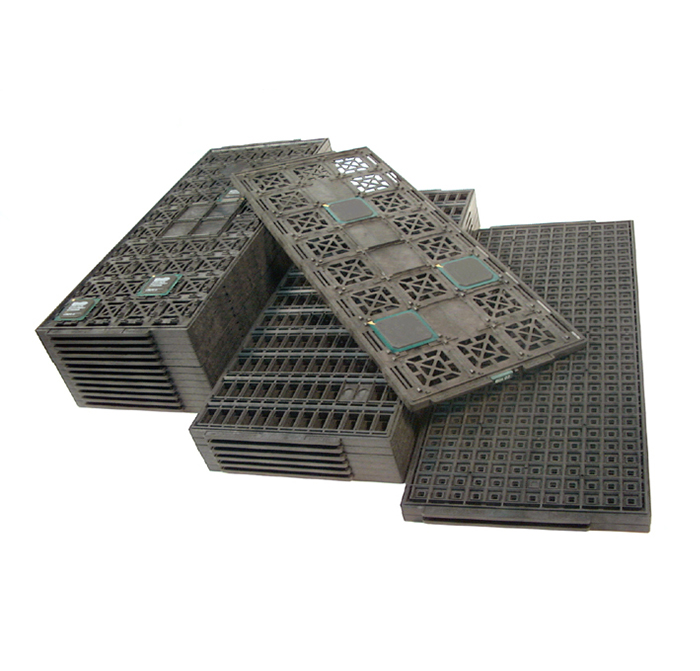
Matrix Trays
ePAK manufactures precision-molded matrix trays for the safe handling, shipping, and storage of semiconductor components. Our tray solutions cover JEDEC, EIAJ, and fully custom outlines, all produced with ESD-safe materials to protect sensitive devices throughout the supply chain.
- JEDEC, EIAJ, and custom tray outlines
- Wide range of materials available to meet your ESD and process requirements
- Patented eBIN™ lot and process identification system
- Patented V-Cut™ tray designs
- Modular insert-tray system for flexible device handling
JEDEC Tray Specifications & Technology
JEDEC, EIAJ & Custom Tray Outlines
Our matrix tray program supports all standard JEDEC and EIAJ tray outlines, as well as custom configurations for components with unique form factors. Whether you need standard QFP, BGA, or SOP pocket formats, or a fully custom cavity layout, ePAK engineers each tray to match your device specifications with tight dimensional tolerances. All trays are available in a wide range of materials to meet your ESD and process requirements.
JEDEC IC Tray Materials, ESD Control & Dimensions
ePAK’s JEDEC tray and EIAJ matrix-tray program is selected around the packaged device rather than one universal pocket size. The Matrix IC Shipping Tray Catalog identifies each IC tray by device or package body size, device height, row-by-column matrix, cell type, profile and material code. Published formats cover TQFP/LQFP, QFP/PQFP, PGA, TSOP/SOIC, QFN/QLP, CSP, BGA and LGA components.
For ESD and anti-static requirements, ePAK lists dissipative material options with published surface-resistivity ranges of 105–1011 and conductive MPPE options at 104–107; maximum temperature depends on the selected grade. Exact pocket dimensions and tray matrix should therefore be matched to the component and process. For separate chip tray applications, ePAK’s current Wafer Catalog lists 2-, 3- and 4-inch tray formats. Contact ePAK with the component size, height, process temperature and required ESD range to confirm the appropriate tray family.
Patented eBIN™ & V-Cut™ Technology
ePAK's patented eBIN™ identification system uses color-coded JEDEC tabs, riders, and detachable studs for sorting and binning while retaining the JEDEC tray outline. The patented V-Cut™ feature enables clean separation of tray sections without tooling, simplifying downstream sorting and kitting operations. eBIN is distinct from the modular insert-tray system described below.
Modular Insert-Tray System
The ePAK modular tray system uses interchangeable inserts within a standard outer frame. This approach minimizes the number of unique tray SKUs required, while offering the flexibility to accommodate new device outlines as your product portfolio evolves. Inserts can be swapped quickly, reducing changeover time in automated pick-and-place and test handler environments.